BERG CODEX
THE AI EQUITY INTELLIGENCE SYSTEM
THE AI EQUITY INTELLIGENCE SYSTEM
Couldn't load pickup availability
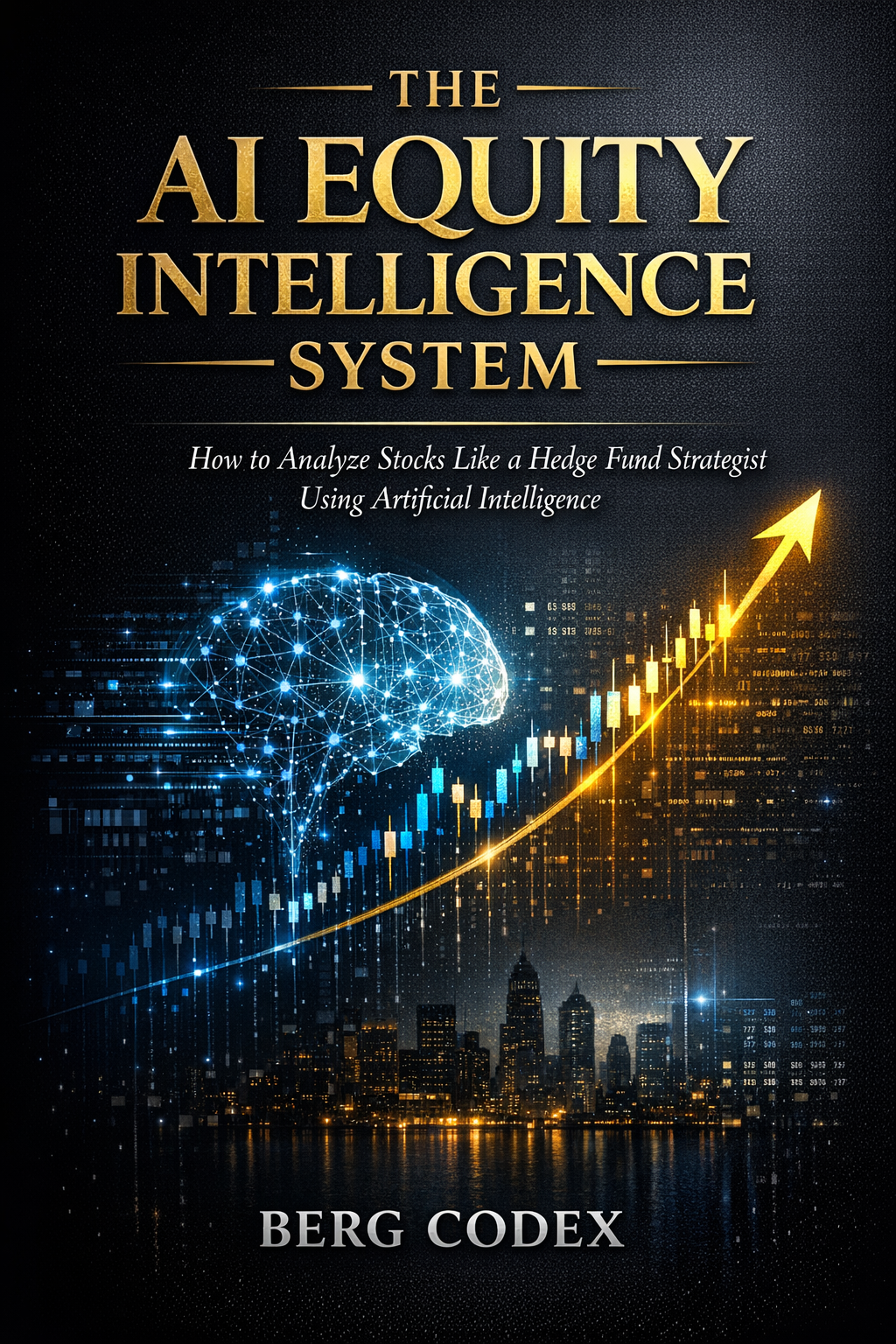
How to Analyze Stocks Like a Hedge Fund Strategist Using Artificial Intelligence
Your analysis stopped keeping up with the market. This book shows you what to do about it.
Stocks are complex. Earnings reports are dense. Valuations require models you were never taught. And most investing content either oversimplifies the process or sells you a system built on hype. If you are serious about equity investing and still feel like you are missing the analytical infrastructure the professionals use, the problem is not your intelligence. The problem is the framework — and this book gives you a better one.
AI Equity Intelligence System by Berg Codex is a 98-page professional stock analysis manual written for serious investors in 2025. It does not sell a trading strategy. It does not promise market-beating returns. It teaches a systematic, step-by-step method for analyzing publicly traded companies with institutional-grade rigor — using AI tools that are available right now.
WHAT THIS BOOK COVERS:
Part One — The AI Revolution in Capital Markets
The book opens by examining why most retail investors underperform not because of bad luck but because of the absence of a structured analytical process. It explains how artificial intelligence has changed the competitive landscape of equity research, how institutional firms are deploying these tools at scale, and why the individual investor now has access to the same cognitive leverage for the first time. This section establishes the foundation for everything that follows.
Part Two — Building Your Analytical Engine
Before analyzing any stock, the book addresses the infrastructure of disciplined research. You will learn how to structure AI interactions for financial analysis, how to eliminate the hallucination risk that makes amateur AI use dangerous, and how to use iterative refinement to build analyses that are precise, verifiable, and grounded in real financial data. This section covers the specific prompt architecture that separates rigorous AI-assisted research from surface-level querying.
Part Three — Screening, Valuation, and Moat Analysis
This is the analytical core of the book. It presents three foundational frameworks every serious equity investor needs:
An institutional equity screening system that filters thousands of companies using valuation, growth, and profitability criteria down to a focused research list. A complete discounted cash flow methodology covering revenue modeling, margin assumptions, weighted average cost of capital, terminal value calculation, and sensitivity analysis. A competitive moat assessment framework built on Porter's Five Forces, network effects, switching costs, brand dominance, and structural cost position.
Each framework is covered in full detail — what it is, how it works, what inputs it requires, and how to apply it immediately to any publicly traded company.
Part Four — Financial Health and Earnings Intelligence
Once a company passes initial screening and valuation analysis, the book shifts to the deeper diagnostic work. This section covers balance sheet stress testing, debt sustainability analysis, cash flow quality assessment, and the specific red flag patterns that precede financial deterioration before it becomes visible in headlines. It then addresses earnings analysis in full — how to read beyond reported numbers, interpret management tone, assess forward guidance, and identify the signals embedded in quarterly results that most investors miss entirely.
Part Five — Scenario Modeling and Portfolio Construction
The final analytical section addresses how to convert rigorous single-company research into portfolio decisions. It covers bull, base, and bear case scenario construction with probability weighting, macro stress testing, position sizing frameworks, risk-adjusted weighting, and the behavioral biases that cause most investors to underperform their own analytical work. This section is for readers who want to build a portfolio that reflects genuine analytical conviction rather than reactive decision-making.
The Repeatable AI Investing Workflow
The book closes with a complete operational system divided into four components: weekly portfolio and universe monitoring, monthly deep analysis protocol, earnings season preparation and response framework, and a semi-annual portfolio review checklist. Each component includes specific processes, analytical priorities, and decision rules so you always know exactly what to do next.
WHO THIS BOOK IS FOR:
This book is written for investors who want to analyze stocks with the same structured discipline that institutional analysts apply at hedge funds and asset management firms. It is relevant for self-directed investors who have hit the ceiling of basic fundamental analysis, professionals who understand finance and want a systematic AI-assisted research process, and serious beginners who want to learn equity analysis the right way from the start.
No programming background is required. No Bloomberg terminal is required. The tools described in this book are widely available. What is required is the willingness to apply a structured analytical framework with consistency and intellectual honesty.
BOOK DETAILS:
Author — Berg Codex Pages — 98 Format — Digital Price — $44.99 Published — 2026 Category — Investing / Equity Research / AI Strategy
Share