BERG CODEX
AI Fat Loss Protocol
AI Fat Loss Protocol
Couldn't load pickup availability
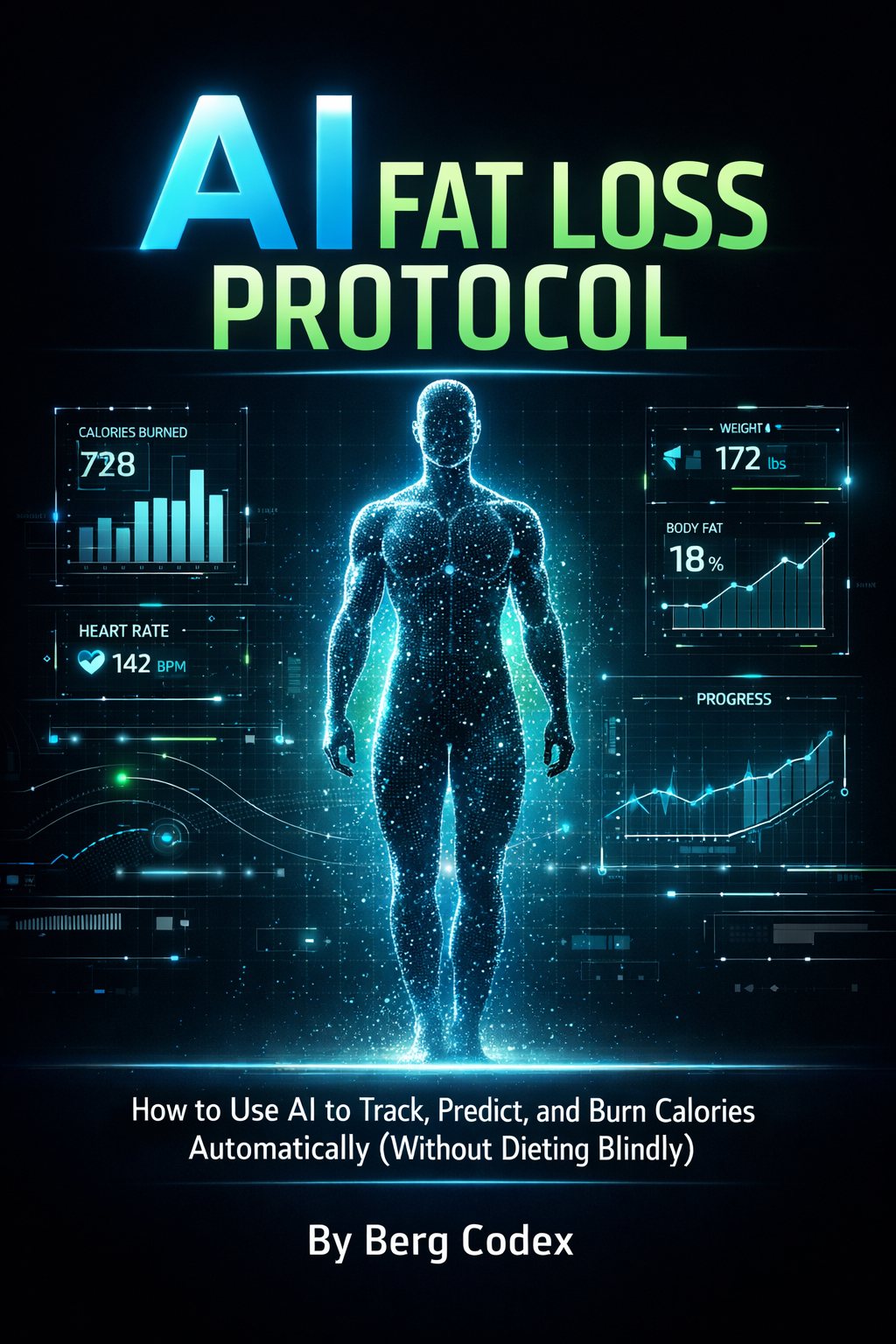
A complete system for tracking, predicting, and burning calories using AI — no guesswork, no rigid dieting.
Most people have tried calorie tracking before. They downloaded the app, logged a few meals, got frustrated — and quietly gave up. Not because they lacked discipline. Because the system was designed wrong.
Manual databases. Endless logging. Zero intelligent feedback. A process built for spreadsheets, not for real life.
This book rebuilds that process from the ground up using AI — the same conversational AI tools already on your phone or computer. Instead of searching food databases and hoping for an accurate match, you describe your meal in plain English and get a full calorie and macro breakdown in seconds. Instead of wondering why the scale stopped moving, you run a weekly diagnostic that tells you exactly where your numbers drifted and what to fix. Instead of following a rigid meal plan that breaks the moment life gets complicated, you run a feedback loop that corrects itself based on your actual results.
The core of the book is the AI Deficit Loop — a four-stage system that tracks your intake, estimates your burn, calculates your real daily calorie deficit, and makes intelligent weekly adjustments. It takes under five minutes a day. Ten minutes on Sundays. And it gets more accurate the longer you use it.
What is inside this 140-page guide:
Part 1 covers why traditional calorie counting fails — including the four specific design flaws that make it unsustainable for most people, and why apps alone never solved the problem.
Part 2 explains how AI actually thinks about your food, where the accuracy margins come from, and how better descriptions lead to better estimates from day one.
Part 3 walks you through building your complete daily tracking workflow — including text-based logging, food photo analysis, and how to integrate AI with any existing tracking app you already use.
Part 4 covers calorie burn estimation — how to get realistic numbers for any workout, how to factor in your daily non-exercise movement, and why most people are overestimating their burn by 25 to 40 percent without realizing it.
Part 5 introduces the AI Deficit Loop in full — the four-stage core framework with daily micro-adjustments, weekly review protocols, monthly check-ins, and a step-by-step plateau diagnostic for when progress stalls.
Part 6 teaches you how to fully automate the system — including a master AI system prompt you set up once, a complete personal prompt library, and a daily ritual that runs in under five minutes with almost no active thinking required.
Part 7 is a done-for-you prompt library with over 40 ready-to-use AI prompts covering daily food analysis, burn estimation, deficit tracking, meal planning, behavioral coaching, and progress prediction.
Part 8 covers the seven most common mistakes that quietly kill fat loss progress — and the exact fix for each one.
Part 9 includes four detailed case studies showing how different people — a busy professional, a working mother, an experienced trainer, and a complete beginner — adapted the system to their specific lifestyle and got results.
Part 10 is a full 30-day implementation roadmap with a specific action for every single day, taking you from first setup to a fully calibrated, running system by the end of the month.
The book also includes a Lazy Fat Loss Protocol for people who want the minimum-effort version, an AI Meal Plan Generator System for automated weekly meal planning, and an Advanced Optimization Mode for people who want to go deeper with techniques like metabolic calibration, macro cycling, and deficit periodization.
Who this is for:
This is for anyone who has tried calorie tracking, lost momentum, and wondered what they were doing wrong. It is for people who are tired of starting over every few weeks. It is for people who want a system that actually responds to their results rather than asking them to trust a formula and hope for the best.
The process in this book does not require a food scale, a nutrition degree, or hours of daily effort. It requires a phone, a free AI tool, and about five minutes a day.
Everything else — the analysis, the calculations, the adjustments, the coaching — the AI handles.
Share